
Process Over Outcome: Why a Single Trade Does Not Matter
The trader's job, in four lines. And why most traders measure the wrong thing.
Most traders measure the wrong thing.
They measure the result of their last trade. They open the app, see green, and feel like a good trader. They see red, and feel like a bad one. Every candle becomes a verdict on their identity.
This is the fastest way to never become consistent.
The market does not work in single trades. It works in distributions. And until a trader understands that difference, every winning trade is luck pretending to be skill, and every losing trade is skill pretending to be a mistake.
The Trader's Job, In Plain Terms
A trader's job is not to predict the future.
It is to recognize a repeating pattern, position around it, and let the market decide the rest.
You find the quality setup. The market decides win or lose. You manage the risk. That is the whole job.
That is it. There is no fourth task. There is no secret indicator that flips this equation. There is no point at which the trader takes over from the market and forces the outcome. The market always decides. The trader only controls the inputs.
> "You find the setup. The market decides win or lose. You manage the risk. That is the whole job."
This sounds simple. It is not easy. Because every part of human psychology is built to resist it.
Why the Brain Fights This Idea
Humans are wired for narrative. When something happens, the brain immediately writes a story explaining why. A win means you read the chart correctly. A loss means you missed something. Three losses in a row mean the strategy is broken.
This is how the brain works. It is also wrong.
A coin flipped one hundred times produces streaks. Five heads in a row does not mean the coin is rigged. It means you flipped a coin one hundred times. The streak is part of the distribution.
Trading is the same. A great setup can lose. A terrible setup can win. The result of any single trade contains almost no information about the quality of the decision behind it.
The brain hates this. The brain wants every result to mean something. So it invents meaning where none exists. And the trader, listening to the brain, starts adjusting the process based on noise.
That is how strategies die. Not from bad math. From traders abandoning them after a normal losing streak.
The Statistical Truth
Here is the practical consequence.
One trade does not matter. What matters is the statistical distribution that shows up after you repeat the same high-quality process hundreds of times.
Think about it the way a casino does. A blackjack table loses thousands of hands a day. The casino does not care. The casino knows that with a small edge applied across enough hands, the math wins. Always.
A trader with a positive expectancy is the casino. The market is the player at the table. Every single hand can go either way. But across hundreds of hands, the edge shows up.
This is the only way to think about trading once you understand the math. Anything else is gambling dressed up in indicators.
The Most Important Distinction
A good trader knows the difference between two things that look identical from the outside:
A good trade that lost
A bad trade that won
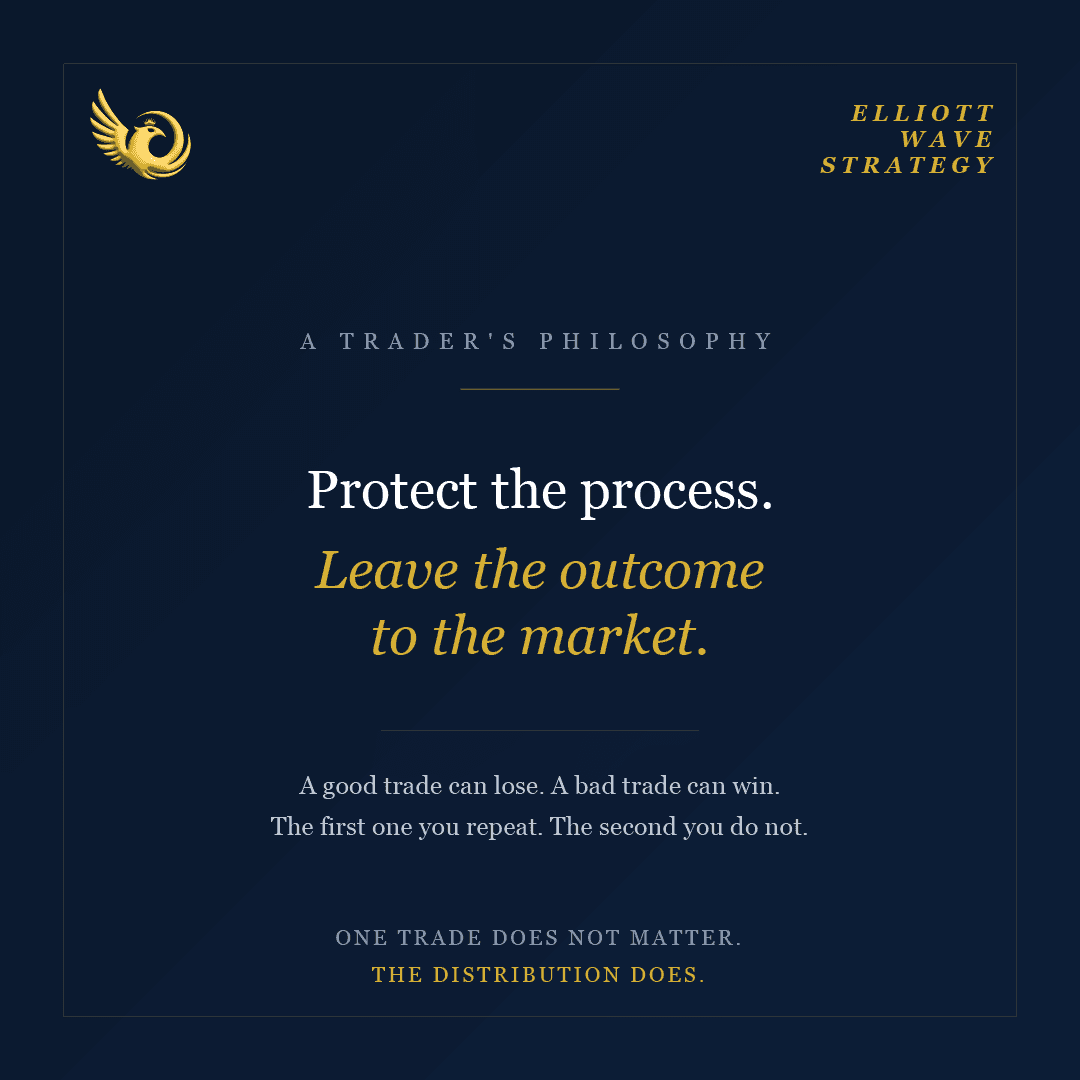
The first one you repeat. The second one you do not. The outcome does not change that.
This is the hardest lesson in trading. Because the brain wants to praise the win and punish the loss. But if you praise a bad trade because it won, you will repeat it. And eventually that bad process catches up to you. The win was a loan from the market. The market collects.
If you punish a good trade because it lost, you will stop taking it. And then you abandon a positive-expectancy process because of one bad sample. You hand your edge back.
The only honest scoreboard is the process itself. Did you follow the plan? Did you size the risk correctly? Did you respect the invalidation? Did you take the setup as it was, not as you wished it to be?
If yes, you did your job. The outcome belongs to the market.
> "A good trade can lose. A bad trade can win. The first one you repeat. The second one you do not. The outcome does not change that."
What This Looks Like In Practice
Here is what a trader who has internalized this looks like.
After a winning trade, they ask: did I follow my plan? If yes, the win is earned. If no, the win is a warning. They know the difference.
After a losing trade, they ask the same question. If they followed the plan, the loss is just part of the distribution. They move on. If they broke the plan, the loss is a lesson. They study it.
They never measure themselves by P&L over a small sample. They measure themselves by execution. Did the plan get followed? Was the risk respected? Was the invalidation honored?
They keep a journal. Not for the trades, but for the decisions behind the trades.
They do not chase missed setups. A missed setup is just a setup that was not for them. The next one is coming.
They size small enough that no single loss hurts. Because they know one trade does not matter. One hundred trades do.
The Premium We Pay
There is a cost to this mindset.
You give up the dopamine of winning. The market gives you no special reward for being right on a single trade. You give up the drama of losing. The market does not care about your story either.
What you get in return is consistency. A career instead of a streak. An account curve that goes up not because every trade wins, but because the math wins.
Most traders cannot pay this price. They want the dopamine more than the curve. So they trade for the feeling instead of the distribution. And the market collects on them, slowly, then all at once.
The Bottom Line
Here is the point, written as plainly as it can be written.
The result of a single trade is not your business. The distribution after one hundred trades is.
Protect the process. Leave the outcome to the market.
That is the whole job.
Frequently asked questions
How does Elliott Wave help with trading psychology?+
Elliott Wave provides a structured framework that reduces emotional decision-making. By identifying where you are in the wave cycle, you can set objective entry, target, and invalidation levels instead of reacting to noise.
What is the biggest mistake Elliott Wave traders make?+
The most common mistake is forcing a wave count to fit a bias. Good analysts always maintain an alternative count and let price confirm which scenario is playing out.
Elliott Wave analyst with 15+ years of experience. Covers 27 instruments daily across Forex, Commodities, Indices and Crypto. Founder of Artavest Oy, Helsinki.