
Reserve Currency Status, in Numbers
De-dollarisation is asserted far more often than it is measured. The four jobs a reserve currency performs, which of them have moved, what would have to change before a shift is real, and how long
Quick answer: A reserve currency does four jobs: it prices trade, it moves payments, it holds official savings, and it denominates debt. The first two are conveniences between governments and can be re-routed by signature, which is why they produce headlines. The fourth is a contract, held by borrowers who never get a vote on the question, and it keeps buying the currency until the last of it matures. Almost every de-dollarisation claim in circulation is about the first two. The numbers that would settle it belong in one chart, built from official data, and it is marked below as the thing this article deliberately does without.
De-dollarisation is the most confidently asserted claim in retail macro and one of the least measured. The pattern is always the same. Two governments announce a settlement arrangement, a share is quoted with no valuation basis attached, and somebody draws a line on a dollar chart.
The claim deserves better treatment than either its promoters or its dismissers give it. Something real is happening at the edges, and its scale is far smaller than the coverage suggests. This article separates the two, then does the part that actually helps: what would have to change, structurally, before any of it belongs in a dollar thesis, and roughly how long each piece takes. You will not find a share, a level or a date below. Those need the measured data series, and the argument does not depend on them.
The four jobs, and the one that is load-bearing
Reserve status is not a title anybody awards. It is a bundle of functions the world hands to whichever unit performs them most conveniently, and the functions can move independently of each other.
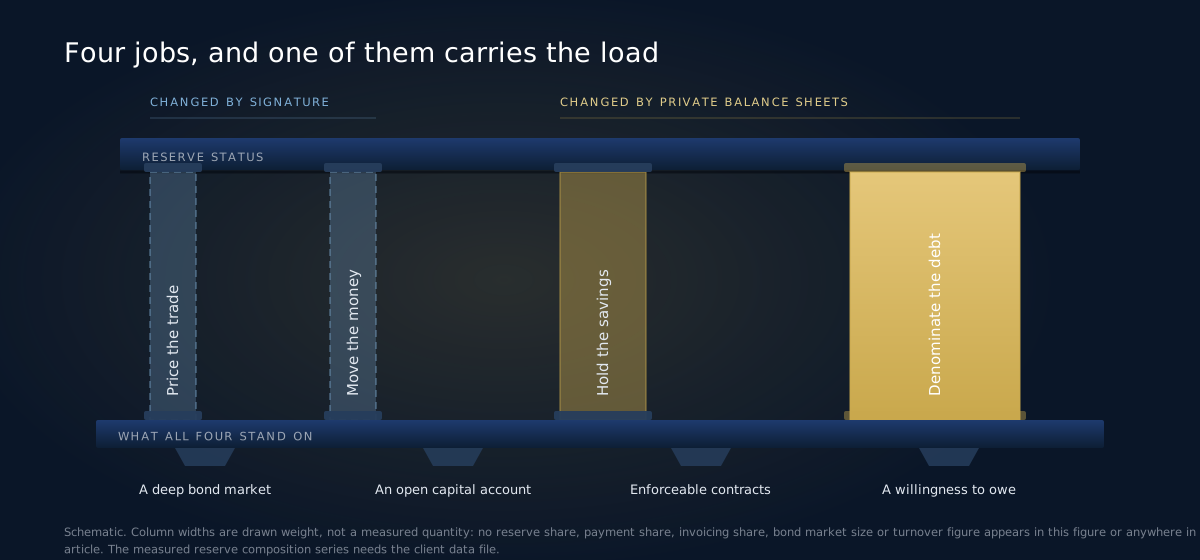
Invoicing is a convention. Two counterparties pick a unit they both quote, and they can pick a different one tomorrow if their governments ask them to.
Payment routing is infrastructure. It is a real barrier and a real cost, and it can be built around, which is what building an alternative rail means.
Holding official savings is a portfolio decision, constrained by what there is to buy. A reserve manager cannot allocate to a market that will not absorb a sale on the worst day of the decade, and that constraint has nothing to do with politics.
Denominating debt is the one that matters, and it is qualitatively different from the other three. When a firm in a third country borrows in a currency, it has created a standing obligation to obtain that currency on a schedule for the life of the loan. That is a price-insensitive, opinion-insensitive bid. It does not care what anyone thinks of the issuing government, and it persists until the debt matures or is refinanced in something else.
What a challenger has to supply
The preconditions are the same for any candidate, and they are uncomfortable for every candidate.
A bond market deep enough to sell into during a panic. Not deep in normal conditions. Deep on the day everybody wants out at once, which is the only day reserve assets are actually tested.
An open capital account. Money that cannot leave will not arrive, and a capital control imposed once is remembered for a generation.
Courts that will rule against the issuing state. A reserve asset is a promise, and the value of a promise depends on whether somebody can enforce it against the promiser.
And a willingness to owe the rest of the world. This is the part nobody campaigning for reserve status wants to hear. Supplying the world with your currency as a savings vehicle means running persistent external deficits, because those are the mechanism by which the currency reaches foreign hands. A country running large surpluses is, by construction, withdrawing its currency from the world rather than supplying it.
Those four sit awkwardly with the political programmes of most of the countries currently discussed as challengers. That tension, rather than any conspiracy, is why the process is slow.
What has moved and what has not
Both columns below are honest. The distinction is which of the four jobs each one touches.
| What has actually moved | What has not moved |
|---|---|
| Bilateral settlement arrangements between specific trading partners | The currency third parties choose when neither of them is involved |
| Alternative payment messaging rails now exist and function | What third countries route through by preference rather than by request |
| Official buyers have diversified reserve holdings, gold included | The absence of an alternative deep enough to take the flow |
| Some commodity trades quoted outside the dominant unit | The financing, hedging and collateral behind those same trades |
| Political willingness to discuss alternatives, openly | The denomination of debt written by private borrowers with no political stake |
The right-hand column is the structural one. Read the two together and the shape of the thing becomes clear: real activity at the transaction layer, almost nothing at the balance sheet layer.
The vehicle currency point deserves its own line, because it is the one most often missed. Two countries settling their bilateral trade in their own currencies changes what happens between them. It says nothing about what a third pair does, and the dominance being discussed is precisely a third-party phenomenon.
What would have to change, and over what horizon
Rank the required changes by how long each one takes, and the argument settles itself.
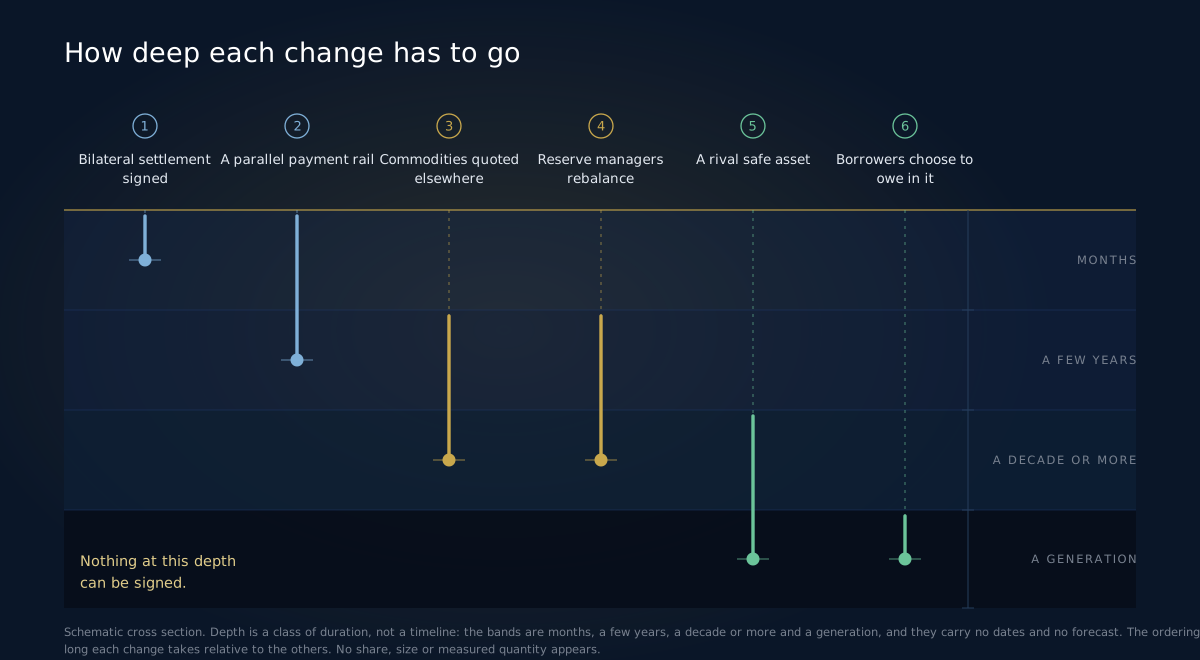
Notice what the horizon actually depends on. The fast items are decisions by a small number of officials. The slow items require thousands of private treasurers, independently, to decide that borrowing in the challenger is cheaper and safer for their own firm. Each of those decisions then lives inside a contract for years.
That is why the process cannot be accelerated by political will, and also why it cannot be stopped by it.
Why share-of-something headlines mislead
This is where most of the damage is done, and it is done with real data.
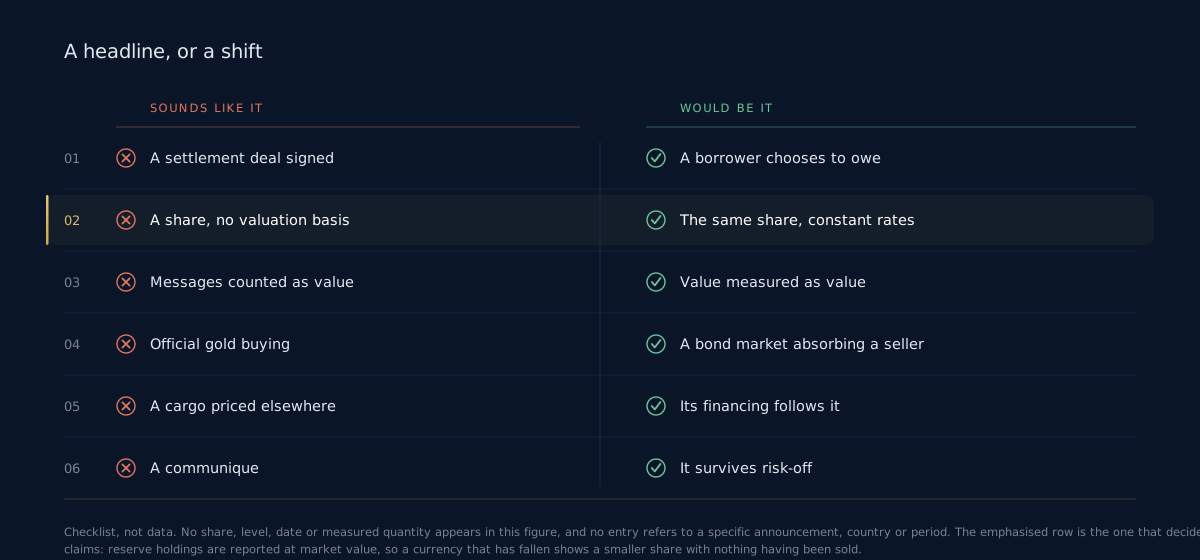
Valuation against flow. Official reserve holdings are reported at market value. If a currency falls, every reserve manager holding it shows a smaller share of the total without one of them having sold anything. Ask whether the series you are being shown is at market rates or at constant rates. The constant-rate version is a different picture, and it is the one that answers the question actually being asked.
Messages against value. Counts of payment messages are not shares of value. A million small transfers and one enormous settlement look very different in one measure and identical in the other.
Bilateral against vehicle. Covered above, and worth repeating because it is the most common error in the entire debate.
Custody against ownership. Where an asset is held and who owns it are separate facts. Movements between custodians get reported as movements in ownership with some regularity.
Gold as a vote. An official buyer adding gold is diversifying a portfolio. It is a real and interesting decision. Reading it as a referendum on a currency assumes the reserve manager thinks like a commentator rather than like a portfolio manager with a mandate.
How the last transition actually went
There is exactly one modern precedent, sterling to the dollar, and it is instructive in a way neither camp enjoys.
The economic crossover happened long before the monetary one. The United States was the larger economy for decades while sterling remained the currency of trade, finance and reserves, because the network, the contracts and the habits were already built. Incumbency is worth a great deal, and it is worth more in money than almost anywhere else, because the value of using a unit rises with the number of others using it.
Then it went, and it did not go smoothly. Two wars, a default on the old rules, capital controls and a series of devaluations, and the role was finished. Slowly, then all at once, is a cliche because it is what happened.
Both halves of that are load-bearing. It took far longer than contemporaries expected, and when it broke it broke faster than anyone was positioned for. Anybody who tells you this is imminent is ignoring the first half. Anybody who tells you it can never happen is ignoring the second.
What this means for a dollar count
Here is the part that touches your chart, and it is smaller than you would like.
The dollar index contains six currencies: the euro, the yen, the pound, the Canadian dollar, the krona and the Swiss franc. No candidate challenger is in that basket. A genuine shift in reserve behaviour would reach DXY only through second-order effects on those six, which is a long and noisy chain.
So on any horizon you can trade, this is not a DXY thesis. A Daily count resolves in weeks and a Weekly count in months. The process described here operates across decades. A view with a decade-long horizon and no invalidation level is not a position, whatever conviction it carries.
If a shift did become real, the expressions would show up elsewhere first: in the term premium demanded on long government debt, in gold as the reserve asset with no counterparty, and in the funding cost of dollar debt for foreign borrowers. Those are the places to watch. The index is the last place it would appear cleanly.
Where this argument could be wrong
Three limits, and the first is the one that keeps me honest about the rest.
The incumbent's advantages are partly self-inflicted assets. Restrictions on access to a currency's payment system, whatever their justification, are exactly the thing that makes holders of that currency reconsider. The incentive to build alternatives is now stronger than it was, and it is stronger for reasons the incumbent chose.
Second, the transition is non-linear. Everything above describes the slow accumulation of preconditions. Preconditions accumulate quietly and then a crisis converts them, and the conversion is fast. My argument is about the base rate, not about the tail.
Third, none of this needs to be complete to matter. A partial shift, where a challenger takes a serious share of trade invoicing and a meaningful slice of official reserves without ever taking the debt denomination role, is entirely possible. That world has a weaker dollar in it without a transition ever occurring.
Quick facts
- No reserve share, payment system share, invoicing share, bond market size, turnover figure or crossover date appears in this article. Those need the measured data series.
- A reserve currency performs four separable jobs: invoicing, settlement, official savings and debt denomination.
- Debt denomination is the load-bearing one, because it creates demand from borrowers who get no vote on the question.
- Reserve shares are reported at market value, so a currency's own move changes its share without any manager trading.
- Bilateral settlement between two countries says nothing about the vehicle currency a third pair uses.
- The preconditions for a challenger include running persistent external deficits, which sits badly with most challenger economies.
- The sterling to dollar transition took decades and then finished abruptly.
- No plausible challenger currency is a component of the dollar index, so this is not a DXY thesis on any tradable horizon.
Frequently asked questions
Is de-dollarisation happening at all? At the transaction layer, yes, and it is real. Settlement arrangements exist, alternative rails work, and official portfolios have diversified. At the balance sheet layer, where the world chooses what to borrow and save in, the evidence is far weaker. Both things are true at once, and most coverage picks one and pretends the other does not exist.
What single number would convince you? The share of cross-border debt issued by borrowers with no political relationship to the issuing country, denominated in the challenger, measured over a full cycle. If that rises through a risk-off episode instead of reversing in the first week of one, the argument is over. Nothing else comes close as a test.
Why does gold buying by central banks not count as evidence? It counts as evidence of diversification, which is what it is. Gold cannot perform three of the four jobs: you cannot invoice a cargo in it, settle a payment in it at scale, or issue debt denominated in it that anybody wants to hold. It is a reserve asset with no counterparty, and that is a different and narrower claim than a currency shift.
How long would a real transition take? Longer than any position you can carry. The precedent took decades, the preconditions here are further from being met than they were then, and the slow steps depend on private decisions nobody can order. Treat it as a frame for the decade, not as a trade for the quarter.
Should any of this change my DXY wave count? No. The count is a structural reading of a specific instrument on a specific timeframe, and it lives or dies at its invalidation level. A multi-decade macro process does not move that level and does not change what the structure says. If you want the dollar index treated properly, the composition of the basket is worth far more of your attention.
Where would I see it first if it did start? In the term premium on long government debt, in gold, and in the cost of dollar funding for foreign borrowers. Those three react to a change in who wants to hold dollar claims well before any headline share does.
COUNT THE STRUCTURE. FRAME THE DECADE. EW Strategy publishes daily Elliott Wave analysis across 27 instruments, 11 FX pairs, 4 commodities, 5 indices and 7 crypto, on H4, Daily and Weekly. Annotated PDF reports on DXY and the major dollar pairs, EWS Helix on WhatsApp when a level goes overnight, and the Fibonacci, position sizing and risk and reward calculators for the part of this that is arithmetic rather than judgement.
Further reading
Frequently asked questions
What is Elliott Wave analysis?+
Elliott Wave analysis is a form of technical analysis based on the theory that financial markets move in predictable wave patterns reflecting crowd psychology. Markets advance in five-wave impulse patterns and correct in three-wave patterns.
How accurate is Elliott Wave analysis?+
Accuracy depends on the analyst's skill, the instrument, and how the result is measured. At EW Strategy, every published call carries a direction, target levels and an invalidation level stated in advance, and every outcome is recorded against them. We are rebuilding that record from the raw archive under a measurement rule published before any figure, and we would rather show nothing than a headline number we cannot defend.
Can Elliott Wave analysis be used for day trading?+
Yes. Elliott Wave patterns appear at all timeframes, from 1-minute charts to monthly charts. Day traders typically focus on sub-minuette and minuette degree waves for intraday setups.
Elliott Wave analyst with 15+ years of experience. Covers 27 instruments daily across Forex, Commodities, Indices and Crypto. Founder of Artavest Oy, Helsinki.