
4 terms
Corrective Waves
The corrective structures, zigzag, flat, triangle, and complex W-X-Y, with rules, guidelines, and trading notes for each.
3.1 Zigzag (5-3-5)
The sharpest corrective structure. Wave A and wave C both subdivide into five sub-waves; wave B subdivides into three.
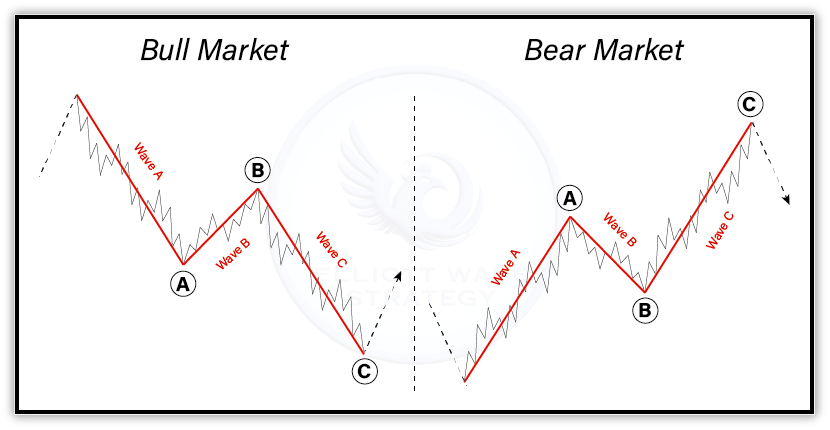
- ·Wave B typically retraces 38.2%–61.8% of wave A.
- ·Wave C commonly equals wave A in length (100% Fibonacci ratio).
- ·Most common form of wave 2 correction.
3.2 Flat (3-3-5)
A sideways correction where wave B retraces most or all of wave A, and wave C ends near or slightly beyond the start of wave A.
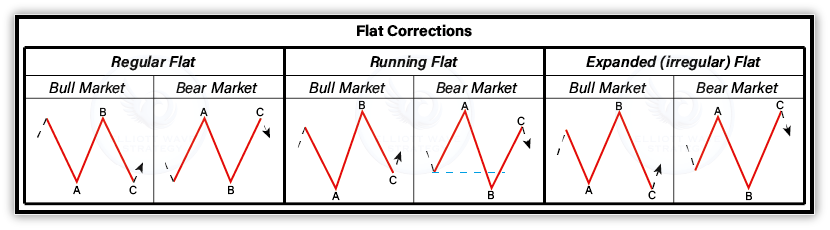
- ·Regular flat: wave B ends near the start of wave A; wave C ends near the end of wave A.
- ·Expanded flat: wave B exceeds the start of wave A; wave C significantly exceeds the end of wave A.
- ·Running flat: wave B exceeds wave A’s start; wave C fails to reach the end of wave A.
3.3 Triangle (3-3-3-3-3)
A five-wave corrective structure where each sub-wave (A, B, C, D, E) subdivides into three, forming a converging or diverging channel.
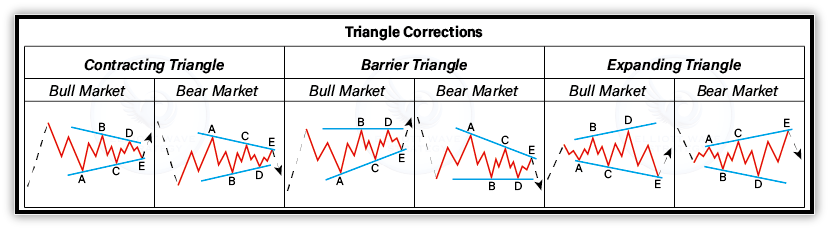
- ·Most commonly appears as wave 4 or wave B.
- ·The apex of the triangle points in the direction of the following breakout (the ‘thrust’).
- ·A triangle breakout provides a reliable entry in the direction of the next impulsive wave.
3.4 Complex Correction (W-X-Y)
A combination of two or three simple corrective patterns linked together by X waves (intervening connecting waves).
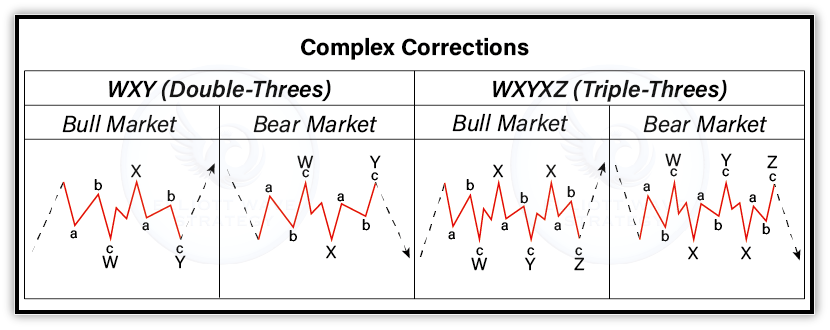
- ·W and Y are each a simple corrective pattern (zigzag, flat, or triangle).
- ·X waves are typically short, three-wave counter-trend moves.
- ·More complex combinations (W-X-Y-X-Z, ‘triple’) occur but are relatively rare.