
5 terms
Impulse Waves
Detailed definitions covering wave extensions, truncations, diagonal structures, and ratio analysis, everything needed to identify and trade impulsive market movements.
2.1 Extension (Extended Wave)
When one of the three motive waves (1, 3, or 5) becomes unusually long and subdivides into its own five-wave structure.
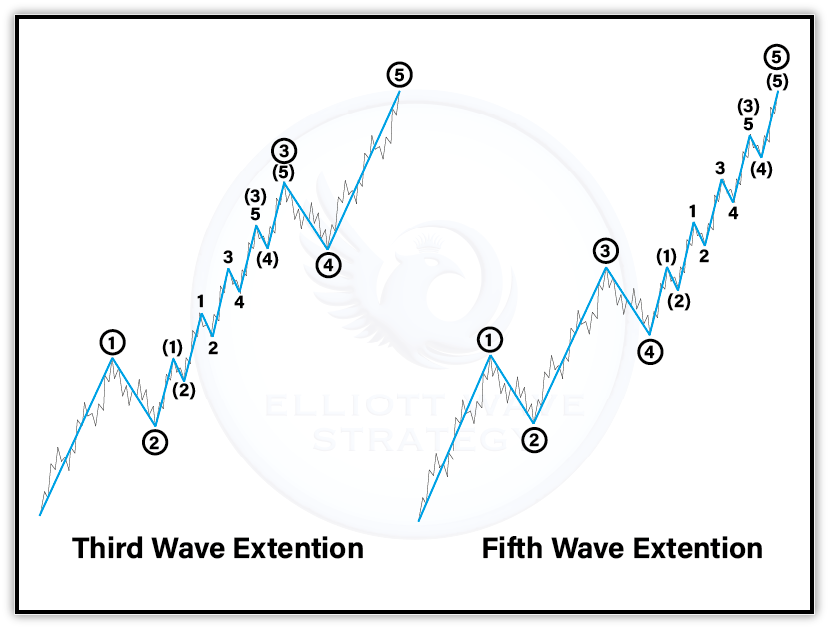
- ·Wave 3 extensions are the most common and most powerful, often reaching 161.8% or 261.8% of wave 1.
- ·Only one wave typically extends in a given impulse; the other two tend to be similar in length.
- ·An extended wave 3 significantly increases profit potential for traders positioned early.
2.2 Truncation (Truncated Wave 5)
Wave 5 fails to surpass wave 3’s peak or trough.
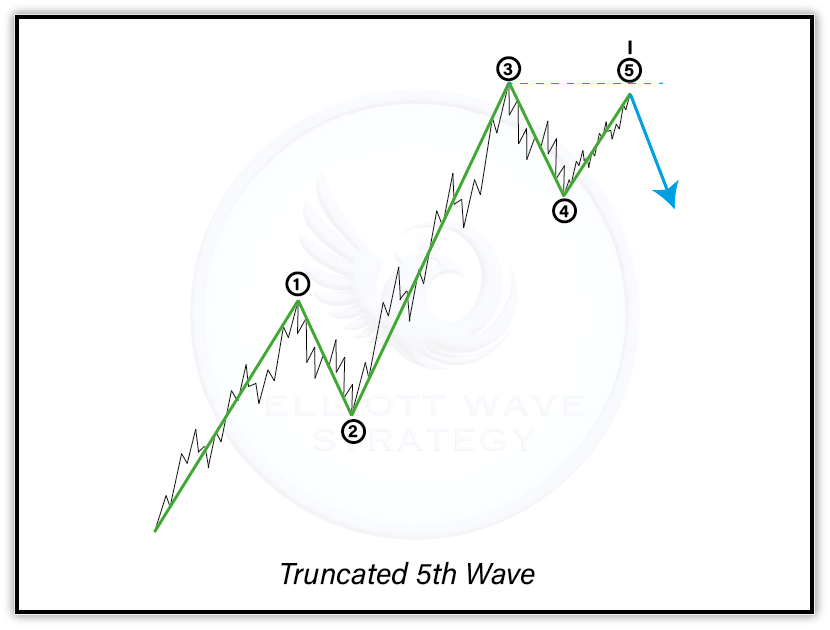
- ·Signals the trend exhausted sooner than expected.
- ·Watch for abrupt reversals if wave 5 truncates, a strong corrective move typically follows.
2.3 Leading Diagonal
A five-wave motive structure with overlapping sub-waves that appears as wave 1 or wave A. Forms a converging or diverging wedge shape.
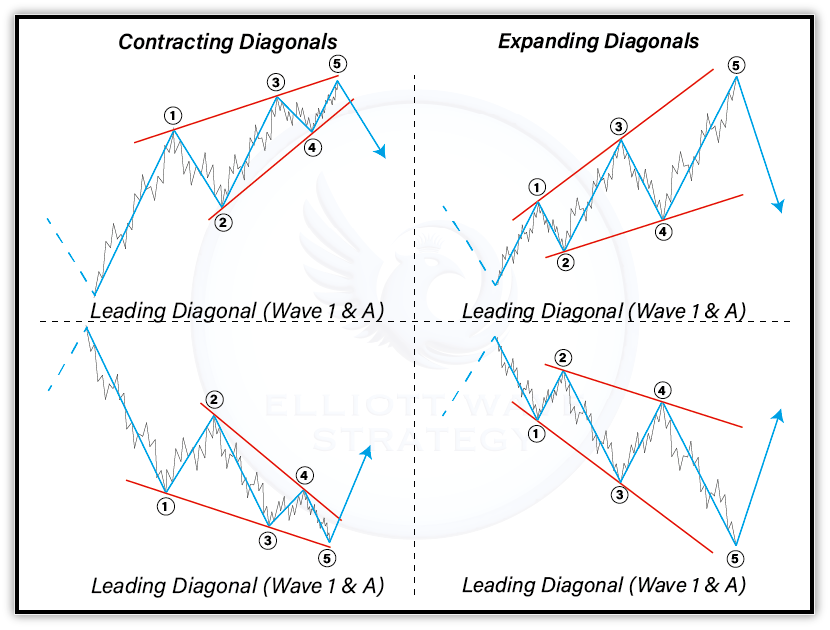
- ·Sub-waves subdivide as 5-3-5-3-5 (converging) or 3-3-3-3-3 (diverging).
- ·Often follows a very sharp prior move in the opposite direction.
- ·Easy to mislabel as a standard impulse, always check for wave 1 / wave 4 overlap.
2.4 Ending Diagonal
A five-wave motive structure with overlapping waves appearing as wave 5 or wave C. Signals exhaustion of the current trend.
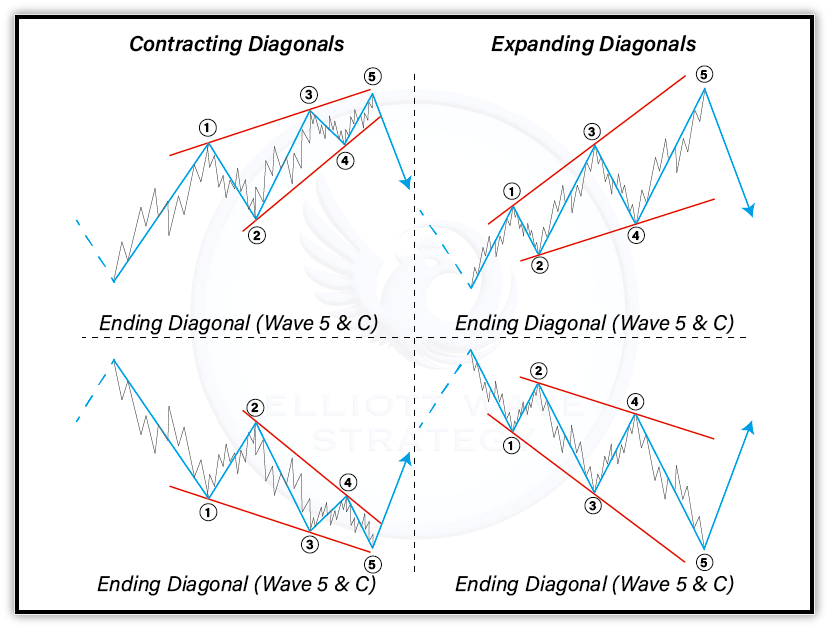
- ·Sub-waves subdivide as 3-3-3-3-3.
- ·A ‘throw-over’ (brief move beyond the wedge boundary) is common just before reversal.
- ·Entries near the apex with tight stops offer excellent risk-reward setups.
2.5 Wave Ratio Analysis
Using Fibonacci numbers to measure wave relationships. Wave 3 or wave 5 length relative to wave 1: typically 1.0×, 1.618×, 2.0×, or 2.618×.
- ·Traders set partial take-profits at Fibonacci extension targets to secure gains.
- ·Wave 2 commonly retraces 50%–61.8% of wave 1; wave 4 commonly retraces 38.2% of wave 3.