
Foundational Terms & Wave Basics
The building blocks of Elliott Wave Theory, from the basic five-wave impulse and three-wave correction to wave degrees, cardinal rules, and the fractal nature of markets.
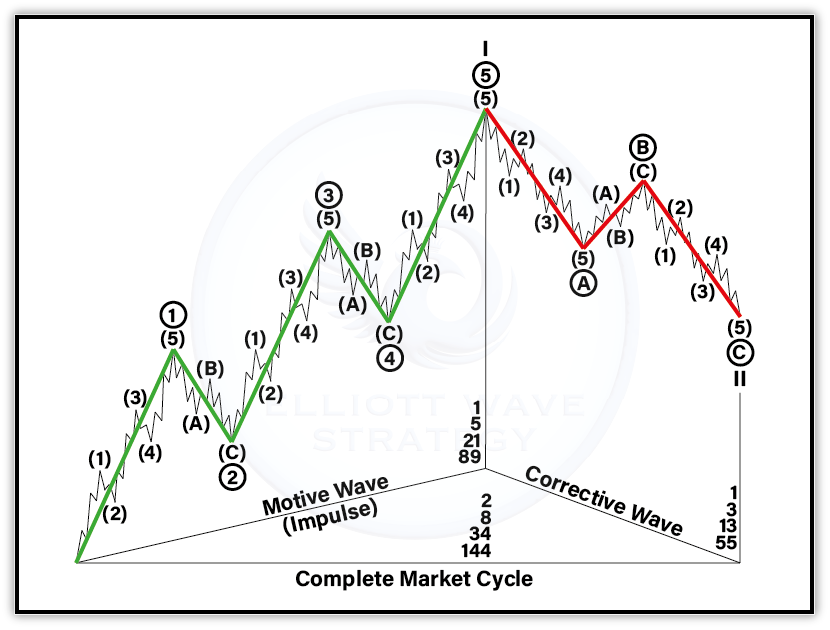
1.1 Impulse Wave
A five-wave sequence (labeled 1, 2, 3, 4, 5) moving in the direction of the dominant or larger trend.
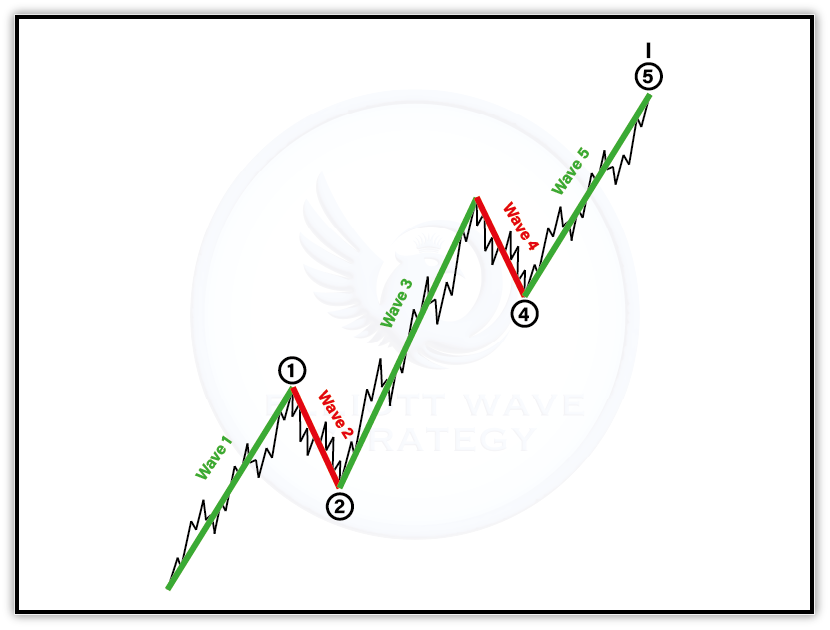
- ·Wave 3 is not the shortest among waves 1, 3, 5.
- ·Wave 2 cannot retrace more than 100% of wave 1.
- ·In a standard impulse, wave 4 does not overlap wave 1’s price territory, any overlap suggests a diagonal or invalid count.
- ·Practical note: Wave 3 is typically the largest and most energetic wave, often aligning with strong momentum or fundamental drivers.
1.2 Corrective Wave
A wave or series of waves (A-B-C in its simplest form) moving against the direction of the larger trend.
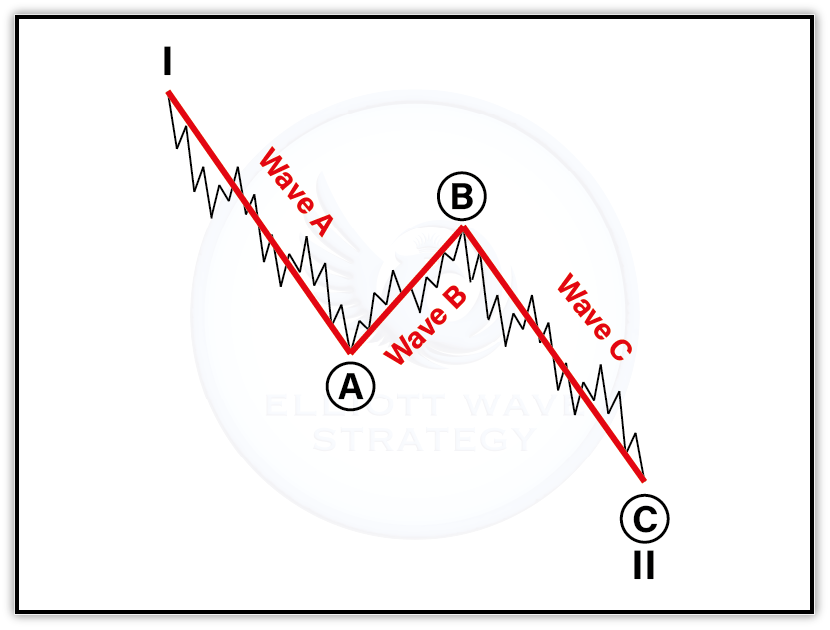
- ·Usually 3 sub-waves: wave A, wave B (a partial reversal of A), and wave C (continuing A’s move).
- ·May form more complex combos (W-X-Y) or patterns (flats, triangles, zigzags).
- ·Corrections can appear deceptively calm or extremely volatile, identifying them properly is crucial to avoiding false entries.
1.3 Motive Wave
Any wave moving in the direction of the trend at the next higher degree, encompasses both impulse waves and leading diagonals.
- ·Subdivides into five smaller waves.
- ·Creates directional, non-overlapping price action (with the exception of diagonal variants).
1.4 Cardinal Wave Rules
The three inviolable rules that define a valid impulse wave.
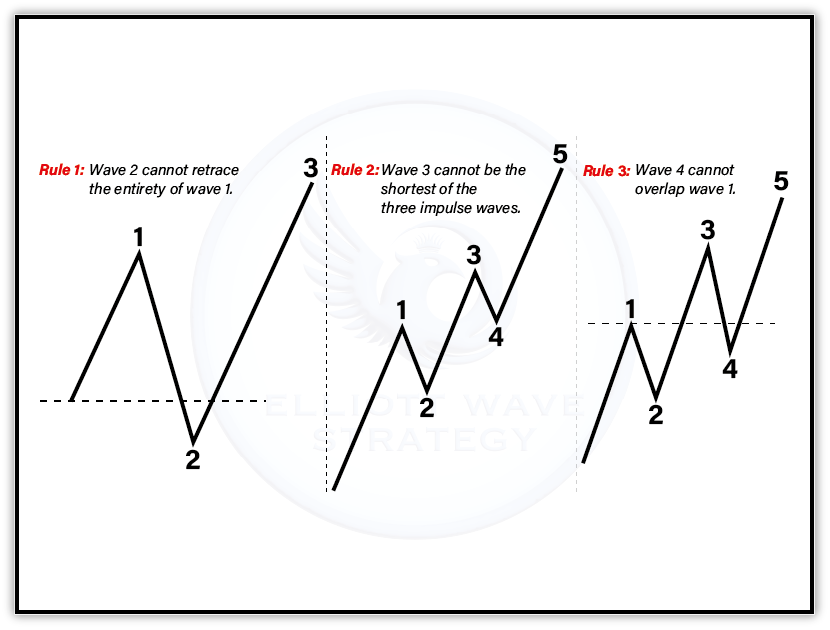
- ·Rule 1: Wave 2 cannot retrace more than 100% of wave 1.
- ·Rule 2: Wave 3 cannot be the shortest of waves 1, 3, and 5.
- ·Rule 3: Wave 4 cannot overlap wave 1’s price territory in a standard impulse.
- ·Each rule defines an invalidation point, if broken, the wave count is incorrect, prompting exit or reanalysis.
1.5 Wave Degrees
The relative size or timeframe of the wave within the overall structure. Elliott identified nine degrees from Grand Supercycle (centuries) down to Sub-minuette (minutes).
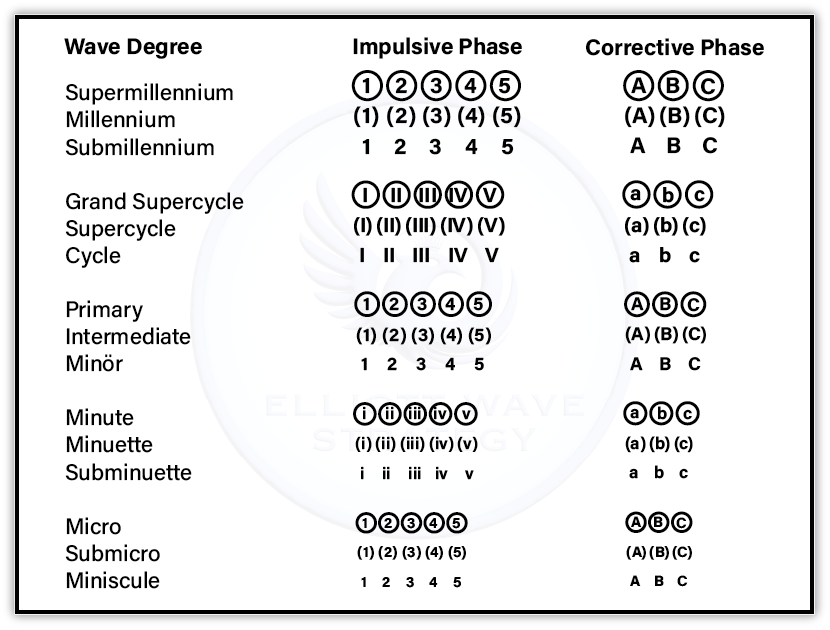
- ·Common trading degrees: Primary (months–years), Intermediate (weeks–months), Minor (days–weeks), Minute (hours–days).
- ·Each wave within a larger wave also subdivides into smaller waves of a lesser degree, the fractal principle.
1.6 Sub-Wave
A smaller wave inside a larger wave. For instance, wave 3 subdivides into five sub-waves labeled (i), (ii), (iii), (iv), (v).
- ·Sub-wave analysis clarifies where you are in a wave’s internal structure, often refining entries or exits.
1.7 Wave Count (Labeling)
The process of identifying and labeling each wave in real time.
- ·Many traders keep a primary and alternate wave count to adapt to new price action.
- ·Flexibility is key, if a count breaks a cardinal rule, the count must be revised, not defended.
1.8 Fractal Nature
Every wave is composed of smaller waves of the same pattern, a self-similar structure that repeats at every timeframe.
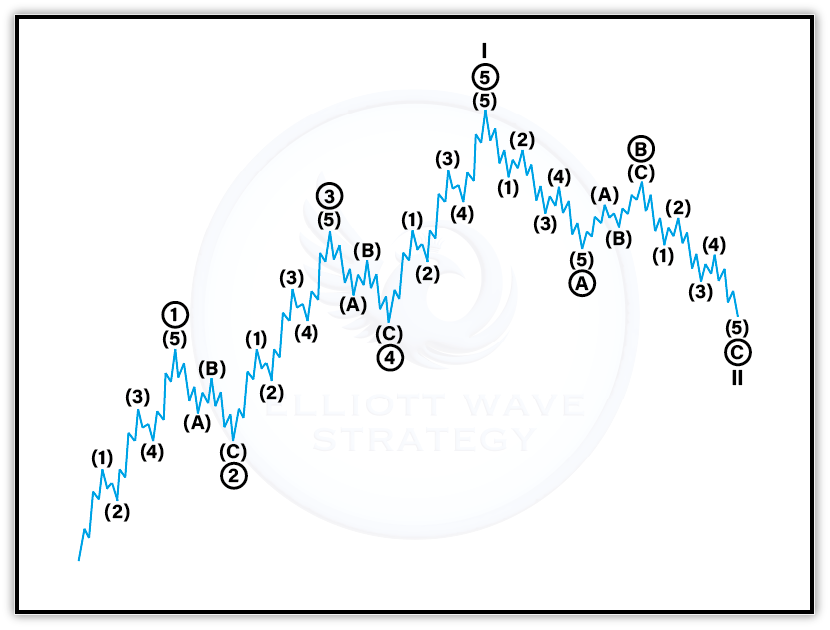
- ·A wave-3 on a daily chart is itself composed of five smaller sub-waves on H4, which in turn contain five on H1.
- ·This property means Elliott Wave analysis can be applied simultaneously across multiple timeframes.